TS2023 Survey Results Announced: Proof of Full Integration and Economic Contribution
The results of the comprehensive TS2023 survey, with participation from nearly 300 households, have been published. With a 100% tax filing rate, massive investments in education, and striking volunteerism rates, the data reveals why a 24-month status extension is vital not only for these families but also for the Canadian economy.
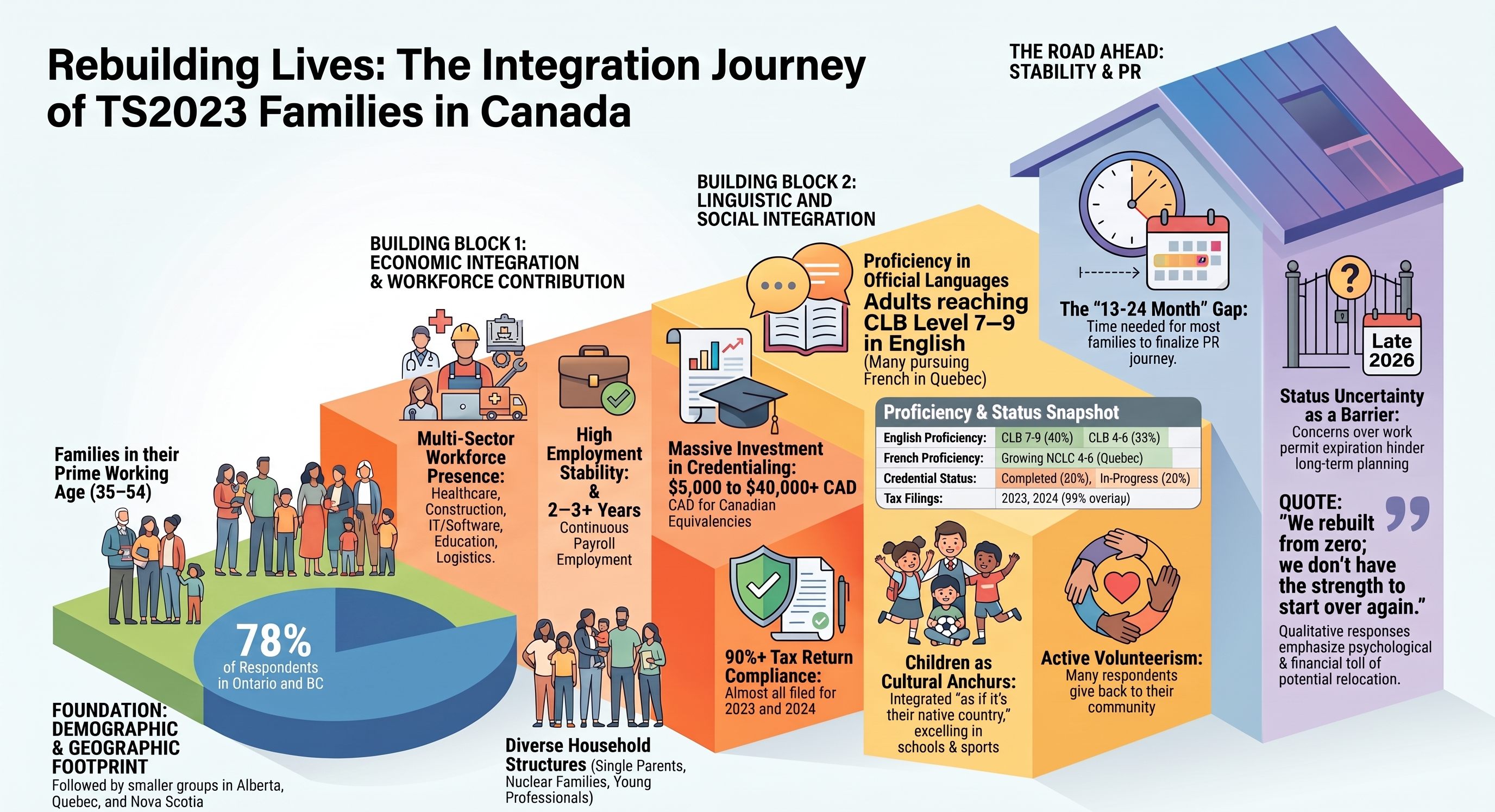
As the TS2023 Initiative, we are proud to announce the results of our comprehensive survey, conducted with nearly 300 households, to assess the current status, integration, and needs of individuals holding work permits across Canada under the TS2023 temporary public policy.
The data statistically proves that temporary work permit holders are not merely a "waiting" demographic in Canada, but a productive, investing, and deeply integrated workforce. Here are the most striking highlights from our report and the interesting correlations brought to light for the first time:
1. Uninterrupted and Full Economic Participation
One of the clearest and most indisputable outcomes of the survey is economic integration.
-
100% Tax Filing Rate: Without exception, 100% of the participating households have filed a Tax Return during their time in Canada, ensuring full legal and economic participation in the system.
-
Job Security and Continuity: 82% of working adults have been actively employed on payroll for more than 1 year (the vast majority for 2-3 years). More importantly, 84% of respondents have a guarantee to continue in their current jobs if their work permits are extended.
2. Striking Data: Merit in "Professional Investment" Directly Impacts Employment
Cross-data analysis of the survey shows that individuals under TS2023 are not just trying to survive; they are making serious investments to fill Canada's skilled labor shortage:
-
51% of participants have obtained a Canadian certification or qualification related to their profession.
-
59% of households have spent at least $5,000 CAD on education and professional equivalency processes.
-
Interesting Correlation: The data reveals that over 60% of individuals who invested $10,000 CAD or more in education and equivalency are now working directly in their field of expertise or a closely related field. This rate is significantly lower for those who did not make such investments. In other words, personal investments in Canadian education directly translate into "the right talent for the right job" for the Canadian economy.
3. Deeply Rooted Families and Canadian-Born Children
The bond these families have formed with Canada goes far beyond simple numbers.
-
The children of 72% of participating families are currently actively enrolled in the Canadian education system (child care, elementary, and high school).
-
57.4% of all children aged 0-5 (infants and preschoolers) are Canadian-born! This demonstrates that a significant portion of TS2023 families have laid their family foundations directly in Canada.
4. Volunteerism and Employment Stability Go Hand in Hand
Proving that adaptation to Canada is not solely financial, the volunteerism rates are remarkable. More than half of the households participate in community projects as volunteers.
-
Interesting Correlation: Survey analysis shows that individuals who participate in community projects (volunteers) are the group with the longest and most stable employment (over 2-3 years) in Canada. (60% of volunteers work long-term, while this rate remains at 49% for non-volunteers). Social adaptation directly supports economic stability.
Why Are We Asking for Exactly a "24-Month" Extension?
As the TS2023 Initiative, our request is not for an open-ended permanent residency (PR), but for a "limited and reasonable timeframe." This is clearly explained by the following survey data:
-
60% of candidates who already have an established roadmap for Permanent Residence (PR) state that they need an additional 7 to 24 months to legally complete their ongoing processes (credential recognition, exams, drawing pools, etc.).
In conclusion; As individuals and families under the TS2023 policy, we are not a burden on the system; we are an indispensable, working, tax-paying part of the Canadian economy, local businesses, schools, and neighborhoods. These survey results prove that the 24-month extension we are requesting is not a privilege, but a logical and necessary step for Canada to retain the skilled workforce it has already trained and integrated into its system.

.png)